Friday, March 29, 2013

EDLD 5364 -Course Based Embedded Assignment Reflection


Overall, I feel I was successful in completing the course assignments. The discussion postings and protocols were the same as I had experienced in other classes. The use of blog post every week was good practice to prepare us for integrating them into classroom instruction. Even the Adobe desktop videoconferencing was easy to participate in and very informative.
            Despite a detailed rubric and guiding questions,  I generally started to feel more comfortable in completing the group project when we were provided with an example. Based on the conversations among my team members, I believe we all felt uneasy about whether or not our project has hit the mark.
            I learned during the project that although my technology skills are well developed, using these skills to construct an interactive, multimedia lesson is more difficult than I thought. Having technology skills alone is not sufficient to promote true integration of technology to teachers in a way that transforms instruction; it is critical to understand educational theory and pedagogy. Depending on my team members, and trusting their educational experience to help design instructionally appropriate lessons infused with differentiation opportunities through technology, led to the development of much better lessons than I could ever have created alone.
Although I have always had an open mind and a positive attitude regarding teaching with technology and using “digital native” tools, during this course my attitude toward student assessment changed. I never thought of a video game as a constant, real-time, ongoing assessment with immediate feedback on performance after each task (Solomon, G., & Schrum, L.2007), and will now look at educational applications of game-like technologies differently. I am now convinced that assessment must be frequent, and just as in a video game, there must be regular, ongoing opportunities for students to monitor their progress and connect the effort they expend to their performance and progress.

 In summation, the lessons I learned in the Teaching with Technology class have changed my attitude towards instructional applications for video gaming technology strategies, improved my online leadership and collaboration skills, and left me with a new respect for teachers who have to find innovative methods to deal with such a wide variety of student skill levels and abilities.


Citation: Solomon, G., & Schrum, L. (2007). Web 2.0: New tools, new schools. Eugene, OR: International Society for Technology in Education, 168-176.

EDLD 5364- Week 5 Post Conference

After viewing the archive of this weeks web conference, I was made aware of what the week 5 expectations are. Usually I scan over the expected assignments and readings before viewing the conference, but this week I did not. The web conference really laid out what I needed to do to wrap up the group website, and my individual task. It also reminded me that there was a Tk20 submission and what the due date was.

EDLD 5364- What I learned Week 5

This week I was taken back by the readings for new technology in the schools. I really experienced an epiphany when I read about new types of assessments in the classroom. I had never thought of video game and application type assessments to monitor the on-going progress of students. This type of assessment can offer varied levels and immediate feedback to the students and teachers. The challenge with this type of assessment is finding or creating one that is rigorous and monitors their progress over time.

Sunday, March 24, 2013

EDLD 5364- What I learned Week 4

This week I had an epiphany regarding assessments after our Week 4 readings. As we trek closer to the STAAR exam, this reading was really appropriate for me. Ultimately, the biggest lesson I learned this week in my Teaching with Technology class is that we must always remember that assessment must be used to evaluate ourselves as teachers, and our teaching methods, just as much as it is used to evaluate student learning. By changing the way we assess our students so that we are truly assessing their knowledge and skills and not just their test-taking ability, we gain a better understanding of how to improve them and how to improve ourselves as well. We must remember that we are all learners, we must learn with our students, and we can build relationships by sharing with them the excitement of creating new knowledge that is self-assessing as the lessons progress.


EDLD 5364- Post Conference Week 4

This week's s conference was more confusing to me. After viewing the archived conference I still was unsure if our group must  complete the examples or if we are simply expressing how we would implement technology activities to solve the scenario. One of my group mates emailed our instructional associate, so hopefully that will clear up my confusion. I think there is a chance that I may be making this more confusing by OVER analyzing the instructions.

Sunday, March 17, 2013

EDLD 5364 UDL Sample Book Link

I created a sample book with the UDL book builder website. Please check it out.

http://bookbuilder.cast.org/view.php?op=view&book=73926&page=1

EDLD 5364- What I learned week 3

This week was informational just like the previous weeks. I gained a better understanding of the Universal Design of Learning, and how to use technology to reach all learners in a classroom. I also learned more about the "digital classroom" and the direction that learning with technology is headed in the future.

EDLD 5364 Week 3- Creating UDL Lesson Reflection

I had the chance to create a UDL lesson plan this week, and it was easier than I expected. My lesson is about the geography of each biome. I have never taught about biomes before, but this was the topic my group chose. I enjoyed creating this lesson, and I think that this is something I will implement in my classroom.

Geography of Biomes

Lesson Overview


Title:
Geography of Biomes


Author:
Jennifer Winston


Subject:
Geography


Grade Level(s):
6


Duration:
2 weeks


Subject Area:
Social Studies


Unit Description:
After researching and reading about biomes, students will be able to identify and describe the geography of each of the six major biomes of the world by making biome mobiles.


Lesson Description for Day:
Read aloud a book about biomes to the class and complete in class assignment.


State Standards:
California Grade 6 5.d  Students know different kinds of organisms may play similar ecological roles in similar biomes.
Grade 6 5.e  Students know the number and types of organisms an ecosystem can support depends on the resources available and on abiotic factors, such as quantities of light and water, a range of temperatures, and soil composition.

Technology Standards:

2.6) Deliver multimedia presentations:
a. Combine text, images, and sound and draw information from many
sources (e.g., television broadcasts, videos, films, newspapers, magazines,
CD-ROMs, the Internet, electronic media-generated images).

e


Goals


Unit Goals:
• Student is able to to describe biomes
Student is able to compare and contrast biomes
Student is able to identify important facts based on prompts.


Lesson Goals:


Unit goals are for each student to identify the geographic characteristics of each biome.


Methods


Anticipatory Set:
Read aloud a book about biomes to the class and ask the following comprehension questions:
• What is a biome? (an environment)
• What are the six major biomes in the world? (tundra, evergreen forest, deciduous forest, grasslands, rainforest, desert)

Explain to students that the biomes often have different types of animals and plants, or fauna and flora, which have adapted to the environment.

Tell students that sometimes, the same animals and plants can live in more than one biome.

Ask students:
• Could a polar bear live in a desert? Why or why not?
• What animal could live in a desert? Why?

Tell students that they will get a chance to find out more about the different biomes because they will be researching and creating biome mobiles.


Recognition Task


Introduce and Model New
 Model for students how to make the mobiles and write the steps on the whiteboard.


Knowledge:

Recognition Task


Tell students that they will first research the different biomes and fill out a Biome printable for each biome. They can use text books, trade books, internet or other resources. Explain the different sections of the printable and the definitions of terms (climate, terrain, etc.). Cut out the biome cards (6 altogether).

Strategic Network


Provide Guided Practice:
Students will then use the blank documents to draw a realistic picture of the biome based on the facts they have collected. Students will then color and cut out the animals and plants on the Flora and Fauna printable and glue the animal and plant that best fit the biome onto the picture.


Strategic Network


Provide Independent Practice:
Students will also draw their own plants and animals on their picture. Students will then cut a piece of construction paper to mount the picture and then glue the biome facts on the back of the construction paper. Students should have six rectangles with pictures of the biomes on one side and the corresponding fact card on the backside. Check students' work to assess understanding of concepts.

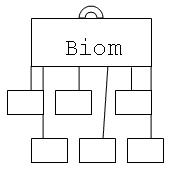
Students can now create their biome mobile. They can cover the hanger with construction paper and punch six holes in the top part. Student can then punch holes in the top of their biome cards to attach the cards to hanger with fishing line. Have students cut varying lengths of fishing line so that the cards are staggered. Student can write "Biomes" or another title for their mobile on the hanger part.

Affective Network


Assessments


Formative/Ongoing                               
Assessment:
Quiz of biome characteristics.


 Ask students to share their mobiles with the class or in groups. These make wonderful decorations in the classroom.


Summative/End Of Lesson

Assessment:


Websites:


Materials:
Lesson Materials
• Hangers
• Construction paper
• Crayons, scissors, pencils, glue, hole punch
• Fishing line
• Printable documents (3 copies of each per student)
• Flora and Fauna printable
• Books about biomes
  Some great suggestions:
  What is a Biome? (Bobby Kalman)
  A World of Biomes Series (Philip Johansson)
  Biome Atlases (Library Binding)


Sunday, March 10, 2013

EDLD 5364- Week 2 Post Conference

I did  not attend the live chat, however I did watch the archived version. I was specifically watching this archive for clarity of the group assignment. After this weeks chat, I have a clearer idea of what the expectations are from this assignments. I was able to better understand the lesson plan requirements, which was helpful to myself as well as my group. I was also able to look at examples of previous group work.

EDLD 5364 What I learned Week 2

This week I had the chance to learn about UDL. UDL stands for Universal Design for Learning.
UDL uses a variety of methods to address the different portions of a learner's brain. There are Recognition Network Tasks which deal with gathering facts and categorizing information, the "what" of learning, Strategic Network Tasks which deal with planning, performing tasks and expressing ideas, the "how" of learning, and Affective Network Tasks which control learner engagement, motivation and interest, the "why" of learning. The lesson model also incorporates both summative and formative assessments to demonstrate the efficacy of the lesson. To learn more, refer to What is Universal Design for Learning?

Sunday, March 3, 2013

EDLD 5364- What I learned Week 1

This week I was excited to learn about the theory of constructivism. This theory was relates to educators facilitating student learning by helping them discover know knowledge coupled with their past experiences. I suppose I am a believer in this theory, because I notice that student retain more when they discover with guidance. Also students learn and retain knowledge when they are able to blend new information with existing information. Teachers are not obsolete in this theory as it may seem.

Constructivism modifies that role, so that teachers help students to construct knowledge rather than to reproduce a series of facts. The constructivist teacher provides tools such as problem-solving and inquiry-based learning activities with which students formulate and test their ideas, draw conclusions and inferences, and pool and convey their knowledge in a collaborative learning environment.


    • Citation: Abbott, J. (nd). Building Knowledge: Constructivism in Learning. [Video file]. Retrieved from http://www.youtube.com/watch?v=F00R3pOXzuk
     
  •  

EDLD 5364- Week 1 Post Conference

This weeks chat was informational, however I was less than excited to notice there is more group work. I just watched the chat on Thursday and started emailing people in my section to find group mates.
Overall, though, it was a positive experience, great questions were asked, and everyone received excellent answers and feedback from our instructor. Despite the the element of group work, there were no technical and user issues.